
(Excerpted and lightly adapted from liner notes by Steve Smith, with his kind permission)
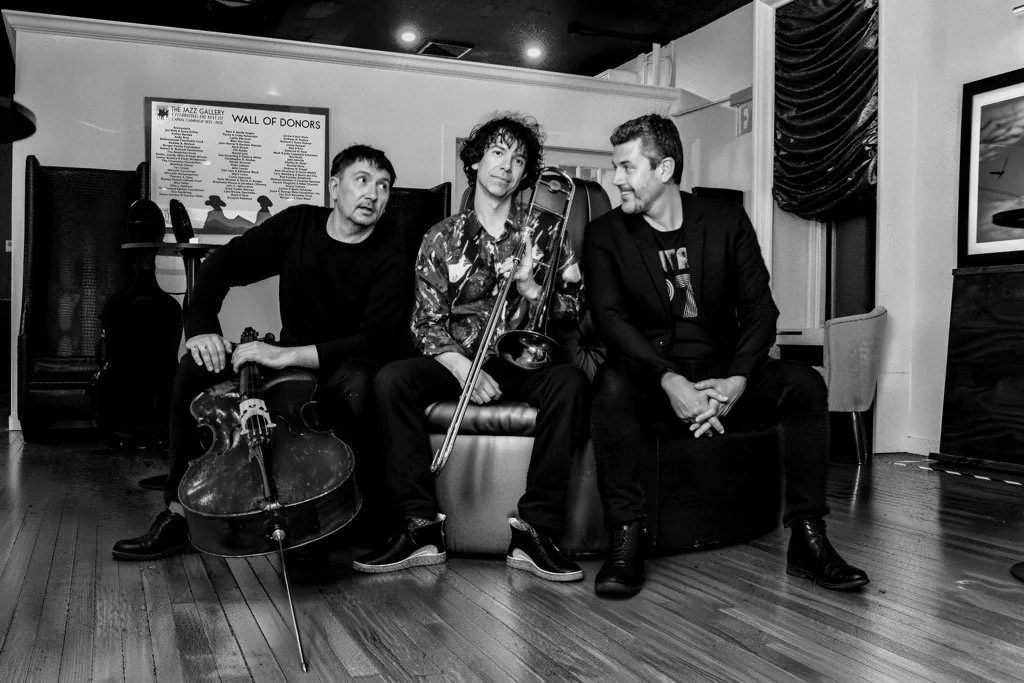
The trans-oceanic chamber jazz trio Reverso—Frank West, piano; Ryan Keberle, trombone; and Vince Curt, cello—last graced the Playhouse stage just days before the world shut down in 2020. But during and after the pandemic, they've continued their Franco-American explorations of the jazz and classical crossroads first mapped by late nineteenth- and early twentieth-century figures like Ravel, "Les Six," and, most recently—the focus of a brand-new album (their sixth), Between Two Silences—Eric Satie.
Satie’s music has long fascinated jazz composers and improvisers, who’ve issued one-off covers and even entire albums of Satie reworkings. But rather than rendering Satie’s compositions in the manner of offbeat jazz standards, Reverso instead offers entirely new music inspired by elements of the composer’s life, character, and musical style. “I was attracted to Satie’s use of space, slow harmonic rhythm, sense of humor, and quirky yet beautiful music,” Keberle says of the music he wrote for the album. “I think that many of these characteristics are also found in Monk’s music,” he continues, “so I was thinking a bit about Monk while I composed my three songs.”
West similarly sought to evoke aspects of Satie’s spirit and idiom. “I was drawn to Satie’s restraint, his sense of irony, and his way of letting silence and space carry meaning,” he explains. “Rather than borrowing his themes, I responded to his attitude: a music that is direct but elusive, rigorous yet playful, and emotionally open without being demonstrative.”
Curt, for his part, reckons Satie would have appreciated Reverso’s idiosyncratic instrumentation. He honors the composer’s penchant for quirky titles with his own “Désespoir agréable” (“Pleasant despair”) and “Choral Hypocrite” (“Hypocritical choir”). “More than for any other composer, the character and his strange, mysterious, and miserable life cannot be dissociated from the music,” Curt says. “Satie represents an entire era, but also emblematic and contrasting places: the cabarets of Montmartre versus the Parisian suburbs at the beginning of the 20th century. And then, of course, humor is always present in Satie's work, which is close to the Dadaist movement. Poetry, absurdity, and provocation are three elements that I try to keep in mind, especially in the most improvised moments.”
What results is a set of original compositions representing an artistic conversation among three creative musicians with individual viewpoints and a fourth participant more than a century distant. With Between Two Silences, Keberle (by now a familiar visitor to Humboldt County), along with West and Curt (on their first return trip) again find inspiration in the art of an estimable forebear—and then tap into the spirit of that art and its maker to fashion something elegant, persuasive, and wholly new.
Thanks to Our Allies
We couldn’t present such world-class artists at such affordable prices without the steadfast support of dozens of RJA members & sponsors, not to mention the community spirit of Arcata’s dynamic arts agency, Playhouse Arts. Special thanks to Bug Press, the most steadfast of jazz allies, for its abiding generosity.

This performance is supported by Jazz & New Music, a program of Villa Albertine and Albertine Foundation.
Additional support for this show comes from Cafe Brio, Dick Taylor Craft Chocolate, George Epperson DDS, John Helie & Monica Simms, North Coast Co-Op, and Zwerdling Law Firm.