
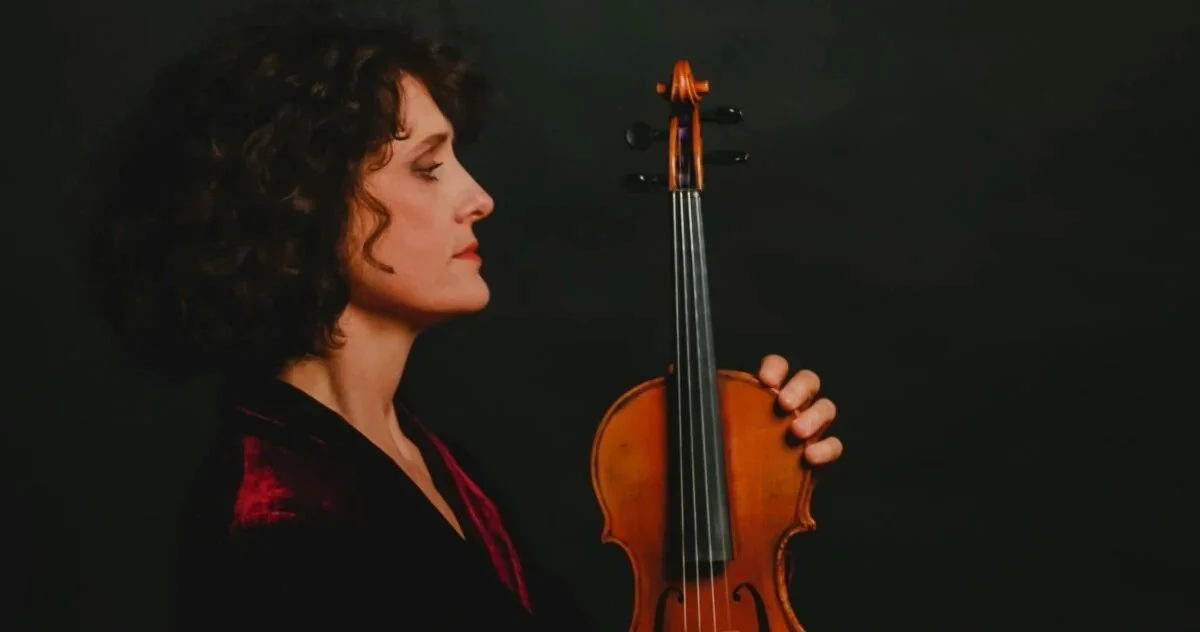
Photo of Jenny Scheinman by Kory Thibeault
It was barely two years ago that Humboldt’s own Jenny Scheinman came home with All Species Parade (the name of both her previous album and her current working band), so let’s assume that neither she nor the other core Paraders—pianist Carmen Staaf, bassist Tony Scherr, and drummer Kenny Wollesen—need reintroducing and instead unpack the music that Scheinman has brought with her on this return trip, which comes from her evocative new album One Hundred Years Today.
The new collection is both a sequel and a prequel to All Species Parade, which explored the fraught history of the North Coast in general and Humboldt County in particular.
In one of the early recording sessions for One Hundred Years Today, Scheinman turned to her fellow musicians and exclaimed, “More apocalyptic! This is end-of-times jazz!” She had reconvened the superb ensemble first heard on that earlier date: the peerless, sensitively attuned piano-bass-drums rhythm section that’s with her tonight, plus guitarists Bill Frisell and Julian Lage. (Denver guitarist Dave Devine ably fills the guitar chair for this West Coast tour.) But with seven new compositions in hand, largely inspired by her Palestinian Jewish grandmother’s travels through Europe a century ago, Scheinman and company were now probing the emotional parallels between the years leading up to World War II and our own troubled present moment. She imagined the music flowing like a secret code passed between generations, a means of creating connection in times of upheaval.
It was the recent discovery of a treasure trove of postcards that provided the conceptual spark for One Hundred Years Today. Scheinman’s grandmother, an aspiring pianist who studied music at the Royal Conservatory in London, eloped from Palestine in 1926 with a young American violinist she’d met on a boat returning from music school. (He was paying his passage by performing in the ship’s orchestra.) The couple spent a decade traveling throughout Europe, playing music, and rubbing elbows with other artists on the underground scene before fleeing to Brooklyn as the specter of Nazism loomed.
The postcards, penned by musician friends during their decade-long travels across Europe, the Middle East, and North Africa, revealed a network of young artists who maintained connections in the face of rapid change, instability, and rising authoritarianism. Scheinman found poetic solace in the ways music and creativity offered a lifeline of hope, and even a means of organized resistance. “In times of struggle, it’s more important than ever to continue making music and art,” Scheinman explains. “It brings joy to the world, but can also let the powers that be know we are listening, and bearing witness.”
Another material link between Scheinman and her grandmother came through the compositional process: much of the album’s music was written on her piano-teacher forebear’s instrument, bequeathed to Scheinman after she passed.
The story of her grandparents is woven throughout One Hundred Years Today, its centerpiece a suite comprising the wistful “Stars of the Lower Deck,” which depicts the couple’s shipboard romance with sensations of tenderness and boundless longing; the buoyant, swinging “Alive at the Kakadu,” named after the Weimar–era Berlin bar where Scheinman likes to imagine her grandmother encountering subversive, unbridled music and theater; and “The Edge of Dawn,” which expresses the first forebodings of something more sinister on the horizon.
Author James McBride captured a sense of history’s cyclical nature in his novel Song Yet Sung, in which runaway slaves communicate via a cryptic code. Scheinman kept a passage from the book hanging on her wall as she composed One Hundred Years Today: “Chance is an instrument of God and the coach wrench turns the wagon wheel.” That dictum provided the title for the album’s opening track, but it also served as its north star. “Music has long been a medium for the transfer of codes,” Scheinman says, “and as such it is part of our survival story.”
Alongside the McBride quote, Scheinman hung another, from Linda Ronstadt’s memoir Simple Dreams, which evokes that legendary singer’s own mid-career ancestral tribute, Canciones de Mi Padre: “They sing so the subsequent generations won’t forget what the current generation endured, or dreamed, or delighted in.” Like a message in a bottle washed ashore, One Hundred Years Today exults in humanity’s eternal need to dream, delight and, ultimately, endure.
(with acknowledgements to Royal Potato Family Records)
(The links above will take you to the website of Playhouse Arts, which handles our online ticket sales.)
Please note that there are
Jenny Scheinman and All Species Parade with guests Bill Frisell and Julian Lage recording “Django in America” at Bunker Studio, Brooklyn
Thanks to Our Allies
We couldn’t present such world-class artists at such down-home prices without the steadfast support of dozens of RJA members & sponsors, not to mention the community spirit of Arcata’s dynamic arts agency, Playhouse Arts.
Special thanks to Bug Press, the most steadfast of jazz allies, for its abiding generosity.

Additional support for this show comes from Cafe Brio, Dick Taylor Craft Chocolate, John Helie & Monica Simms, Josh Meisel & Mary Virnoche, and North Coast Co-Op.