
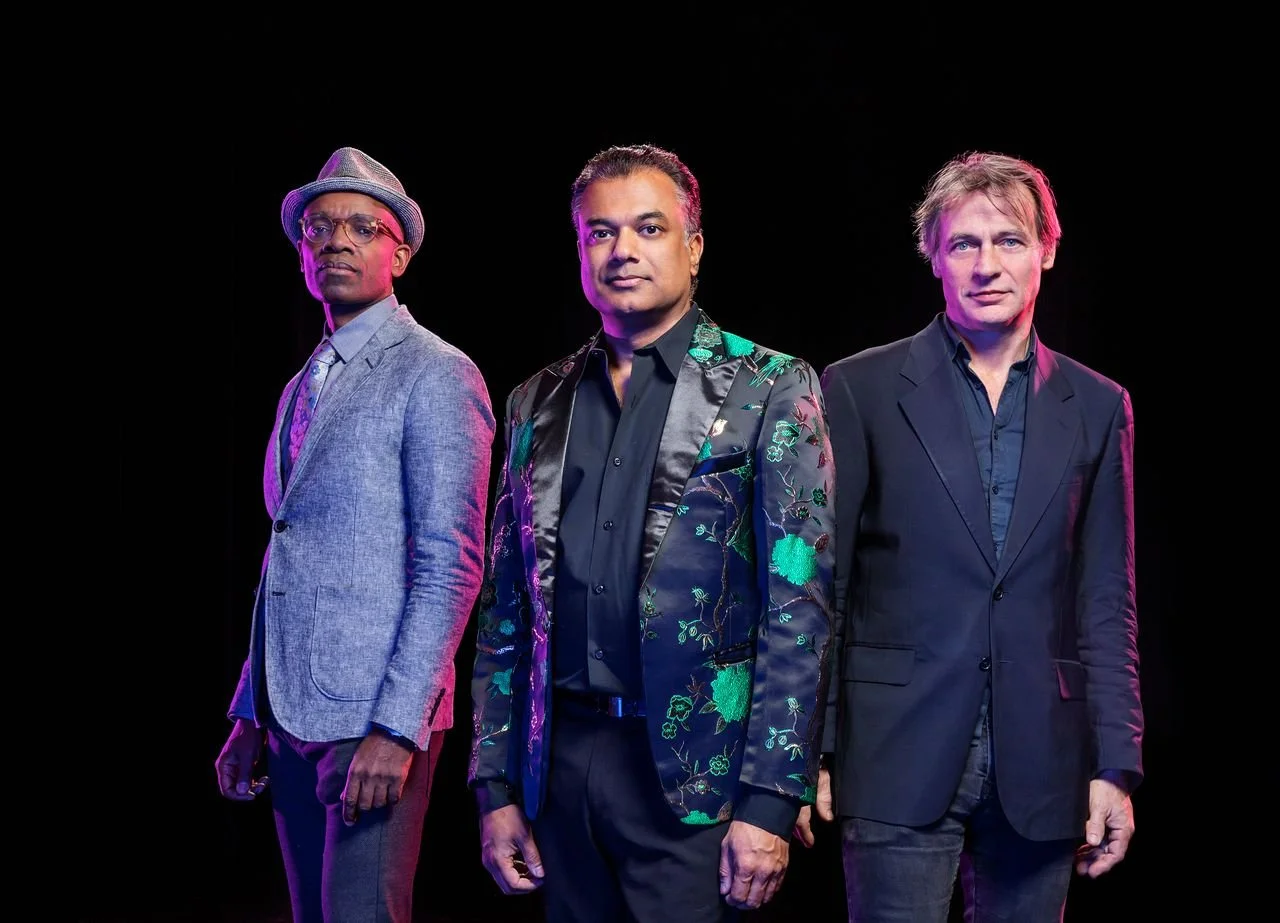
It’s not surprising that pride of place in alto saxophonist Rudresh Mahanthappa’s pantheon would belong to the legendary Charlie Parker, who served as the inspiration for “Bird Calls,” the quintet (and 2015 album of the same name) that dazzled critics and audiences worldwide—including here in Humboldt, when they winged into the Kate Buchanan Room in October 2016. For the follow-up, Rudresh pared things down to a trio of superfriends—himself, bassist François Moutin, and drummer Rudy Royston—and opened things up to a broad array of personal idols: Bird again, plus other saxophone colossi like Sonny Rollins, John Coltrane, Lee Konitz, and Ornette Coleman; but also 70s jazz superstars like Keith Jarrett, Pat Metheny, and Chuck Mangione, as well as pop and country icons like Stevie Wonder and Johnny Cash, whose work Mahanthappa has always found “beautiful, humorous, pensive, and utterly joyful.”
Recording sessions for the debut Hero Trio album finished in January 2020, with release slated for June. And then, like so much else in that awful time, the project was largely lost to the oblivion of COVID: tours were canceled, audiences vanished, artist infrastructure imploded, publicity fell into a void. In the years since, Mahanthappa has valiantly reconvened the trio, in an effort to fill the hole and bring the music to live audiences at last, with some success. But as jazz writer and broadcaster Nate Chinen remarked in a touching Substack post just last year, “there’s no telling what Hero Trio’s impact might have been in normal times.”
That said: Kevin LeGendre of Britain’s JazzWise magazine (which named the album a standout of 2020) argues that even in the studio, the trio’s “central achievement” is to have “bridg[ed] the gap between supposed high and lowbrow…with sparkling cocktails of grooves, hooks and solos that unfurl in structures that can be straight and not so straight.” “There’s a radiant joy” in their recorded performances, adds Bandcamp’s Dave Sumner: “Each musician takes turns jumping to new heights and spurring on their counterparts to do the same.” And “[t]he result,” says LeGendre, “is an overwhelming feeling of joy”—that word again—“amid all the ‘chops’, a desire to emote as well as excel technically.” By his own account, Mahanthappa selected source material for Hero Trio that helped him, and ideally would help listeners, “look beyond the illusory boundaries of genre” to focus on “music as a magical force that binds humanity.” Tonight, Mahanthappa, Moutin, and Royston summon all their superpowers to bring that joy, that magic, to the Playhouse stage and to all the humans in this room.
Born in 1971 in Trieste to Indian émigré parents, Mahanthappa grew up in Boulder after his physicist father joined the faculty at the University of Colorado. In grade school, Mahanthappa soaked up the sounds of Grover Washington, Jr. and David Sanborn, the Yellowjackets and the Brecker Brothers. But an encounter with Charlie Parker’s Savoy sessions, he says, “really rocked my world,” so much so that he went on to study music at North Texas, Berklee College, the Stanford Jazz Workshop, and Chicago’s DePaul University. Soon after moving to New York in 1997, he found a musical confederate in pianist Vijay Iyer; over an explosive decade in each other’s bands and in the co-led Raw Materials, the pair made their names with an arresting string of releases that foregrounded their inventive methodologies and idiosyncratic approaches to composition and improvisation.
Mahanthappa’s creative evolution was further shaped by an encounter with Carnatic master Kadri Gopalnath, who decades earlier had introduced the saxophone into the classical traditions of southern India; their 2008 collaboration Kinsmen inaugurated a string of projects with a variety of ensembles (including the “Indo-Pak Coalition” with fellow RJA veterans Rez Abbasi and Dan Weiss) that explored new strains of South Asian fusions. At the same time, Mahanthappa found another powerful mentor in veteran altoist Bunky Green, an unsung Chicago-based player and educator with an outsized generational influence. Since 2018, Mahanthappa himself has been Director of Jazz in the Music Department of Princeton University.
Now recognized as one of definitive saxophonists of the 21st century, Mahanthappa is a perennial chart-topper in all the prestigious critics’ polls, while his records—17 as a leader or co-leader—regularly appear on year-end “best” lists. His cast of collaborators includes numerous figures of comparable distinction—not only pianist Iyer, guitarist Abbasi, and altoist Green, but also saxophonist Steve Lehman, pianist-composers Danilo Pérez and Arturo O’Farrill, and drummers Jack DeJohnette and Terri Lyne Carrington.
The bonds between Mahanthappa and his “heroic” bandmates, meanwhile, were forged decades ago. He and Rudy Royston were pals growing up in Colorado and bandmates there in the early 1990s. They rekindled their connection after Royston relocated to New York City in the mid-aughts. Since then Rudy has become one of the music’s most sought-after sidemen, a standout drummer on a scene overflowing with extravagant talents. (Royston was once a frequent visitor to the RJA, but hasn’t returned since a February 2020 visit at the helm of his “Flatbed Buggy” quintet.) Paris-born bassist François Moutin, in similarly high demand, met Mahanthappa in the fall of 1997 within weeks of their respective moves to New York City; they’ve collaborated regularly ever since.
Thanks to Our Allies
We couldn’t present such world-class artists at such affordable prices without the steadfast support of dozens of RJA members & sponsors, not to mention the community spirit of Arcata’s dynamic arts agency, Playhouse Arts. Special thanks to Bug Press, the most steadfast of jazz allies, for its abiding generosity.

Additional support for this show comes from Cafe Brio, Dick Taylor Craft Chocolate, Bob and Amy Doran, and North Coast Co-Op.